Your commute is almost certainly noisy. Whether you’re trying to drown out the screech of the train or a chatty passenger on the bus, all you need is pair of excellent noise-canceling earbuds to make it all go away.
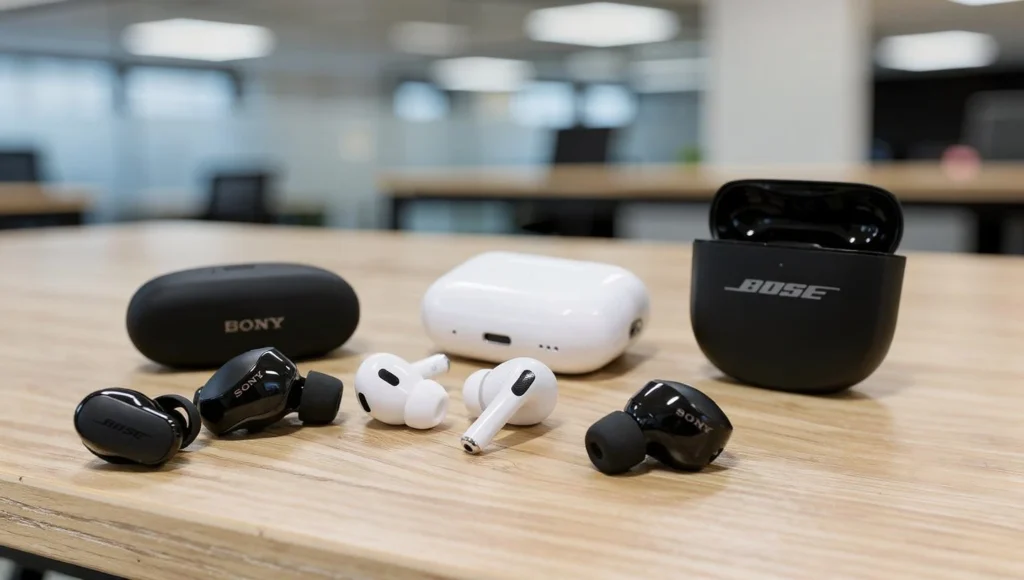
We have been testing wireless earbuds and headphones for over two years now. During that time, we reviewed dozens of models across every price range, from budget picks under $50 to flagship pairs from Sony, Bose, and Apple. I’ve tested over 100 noise canceling earbuds to find my top picks.
The first time I put on noise-canceling earbuds was back in 2022. I bought a pair of Bose QuietComfort Ultra to use on the NYC subway paired with my iPhone 13. With a quick press on the buds, the world faded to silence, and what was left was just my music playing clearly in my ears.
I live in Brooklyn where noise is constant. The sounds of the streets, the screech of the train, traffic noises, chatty passengers on the bus. I couldn’t believe how much the noise canceling actually blocked out. But how does this technology actually work?
Small Microphones Pick Up Ambient Sound
Active noise cancellation uses built-in microphones to detect incoming noise from your surroundings. The microphones pick up ambient sounds and analyze their frequency and amplitude.
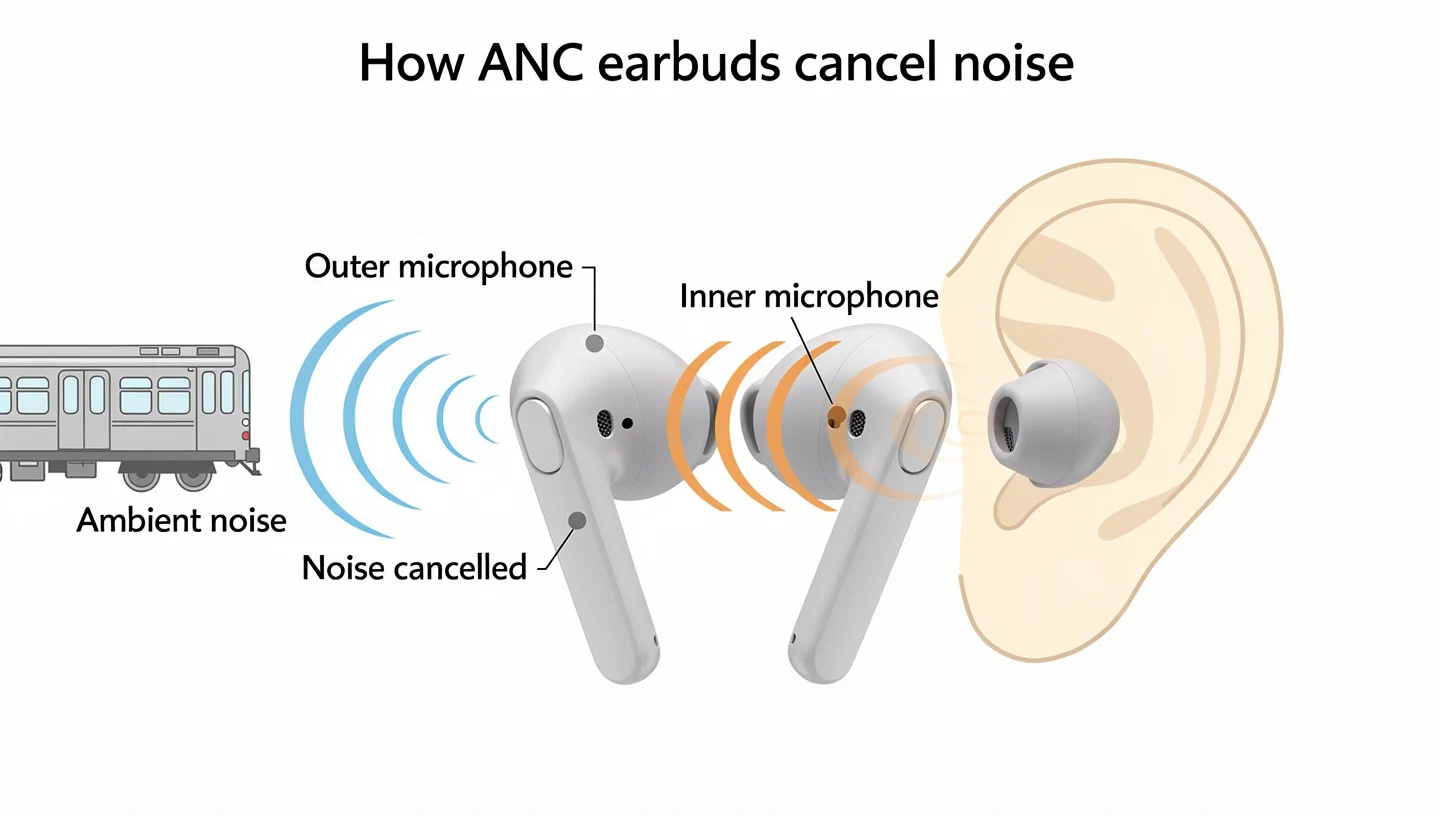
ANC earbuds rely on small microphones built into the housing. These microphones continuously sample environmental noise, whether you’re seated on an aircraft, standing in a crowded office, or walking along a busy sidewalk.
Think of it like two waves meeting in water. When one sound wave hits its highest peak, the other is at its lowest. The peaks and troughs are opposite, and the waves cancel each other out.
I tested the Bose QuietComfort Ultra Earbuds 2nd Gen on the subway in Manhattan. The clackety-clack rumble was effectively blocked out. Engine noise was barely audible, and the rhythmic clacking of wheels on tracks was dampened.
An outward-facing microphone analyzes and detects the external noise coming into the earbuds. A microphone positioned inside the ear canal picks up residual noise that makes it past the outer seal. Before that leftover sound reaches your eardrum, the system cancels it.
The ANC Processor Generates an Inverse Wave
The ANC processor inside the earbud analyzes that incoming sound in real time. It identifies the frequency and amplitude of the noise, then generates an opposite sound wave. This is called an anti-noise signal.
The processor analyzes the noise and generates an inverse wave with the same amplitude. When these two waves combine, they create destructive interference, effectively canceling out the external noise.
Sound waves carry energy through alternating peaks and valleys. Two waves at matching frequency but opposite amplitude neutralize each other completely. It’s like adding -1 to +1, you end up with zero.
The circuitry combines the signal, and the speakers emit the anti-noise to your ear. The opposing signal plays through your earbud drivers at the exact moment the original noise arrives. The two waveforms collide and the unwanted sound disappears.
This entire process happens thousands of times per second. Modern ANC chips can react fast enough that you don’t notice any delay between the noise hitting the microphone and the anti-noise being generated. This happens in real-time and continuously adapts to the changing noise environment.
I’ve been using the Sony WF-1000XM5 for three months paired with my Pixel 7. In my experience, the noise canceling is incredibly impressive. They’re positively tiny, despite their very impressive internals bringing plenty of features besides their excellent ANC.
The sounds of the streets were much quieter, as loud tire and engine noises were drowned out by a combination of ANC and my music.
Feedforward, Feedback, and Hybrid ANC
There are different types of active noise cancellation. Not all noise canceling is the same.
Feedforward ANC uses microphones on the outside of the earbud to detect noise before it reaches your ear. It is effective but cannot account for how the noise changes once it enters the ear canal.
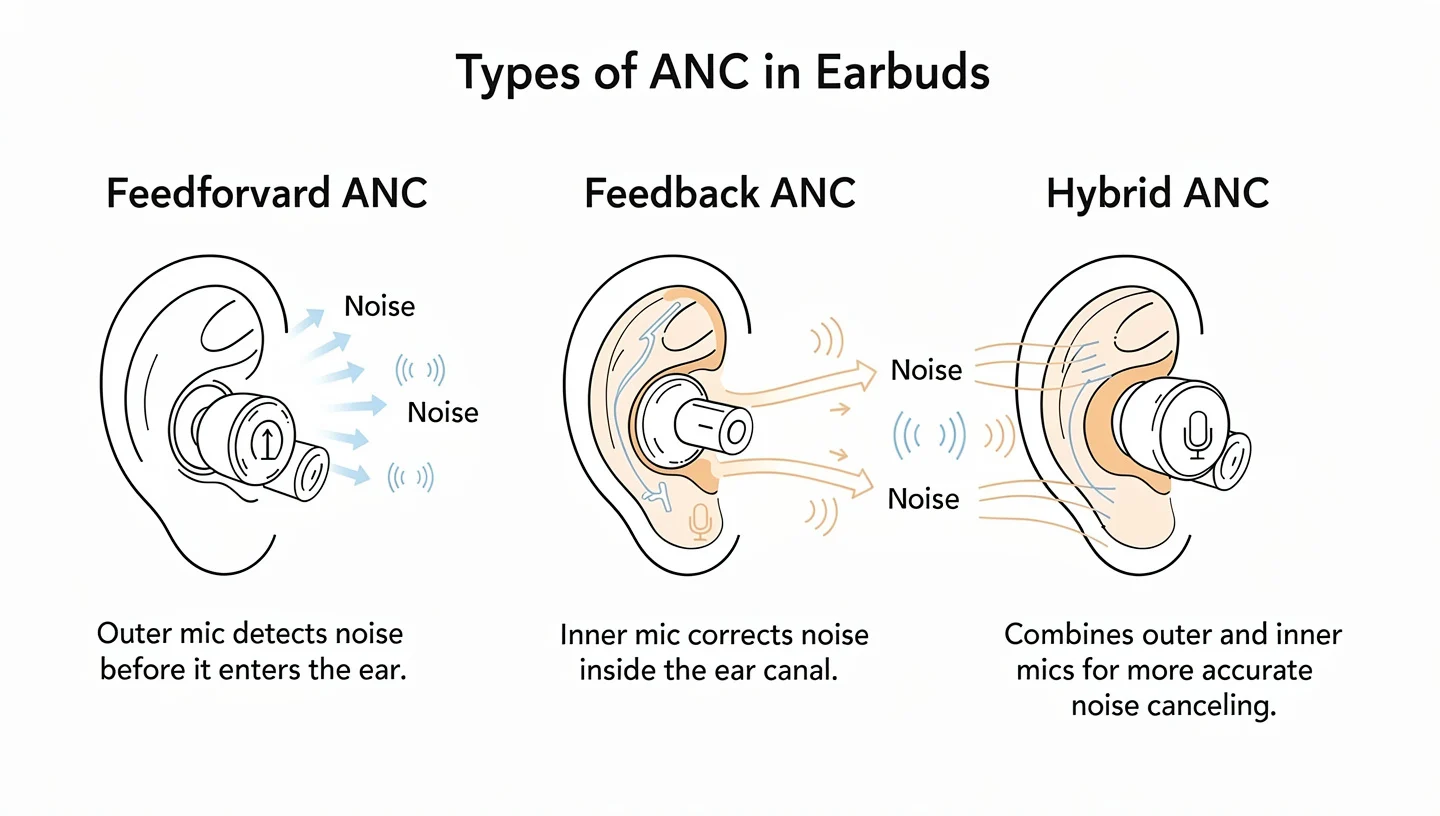
Feedback ANC uses a microphone inside the earbud, closer to your eardrum. It picks up sound that has already entered the ear canal and corrects for it. This type is better at handling inconsistencies but slower to react.
Hybrid ANC combines both feedforward and feedback microphones. This is what most premium earbuds use today, including the Bose QC Ultra, Sony WF-1000XM5, and AirPods Pro 3. It gives the most accurate noise canceling because the system can detect noise both before and after it enters your ear.
The ANC is, as you might expect, very good on premium models. It’s not quite up there with the Bose buds on every model, but many still do a stellar job of keeping the noise of your commute to a minimum.
I first noticed this during my trip on the train with the Sony earbuds. My trip was quietened, silencing the noisy soccer fans at the other end of the carriage, and kept the noise of the train at bay.
For the Technics EAH-AZ100, ANC performance is strong and consistent across frequencies. It handles airplane noise and busy commutes well, and while the raw noise reduction is a touch behind Bose and Sony, the difference is small in real-world use.
Adaptive ANC goes a step further by automatically adjusting the level of noise canceling based on your environment. Move from a quiet room to a noisy street, and the earbuds increase ANC strength without you touching anything. This feature is available on most flagship and many mid-range earbuds in 2026.
Passive Isolation Works Alongside Active Canceling
There are two types of noise reduction in earbuds, and the best noise canceling earbuds use both.
Active noise canceling is the electronic process described above. It works best against constant, low-frequency sounds like airplane engines, train noise, air conditioning hum, and road traffic.
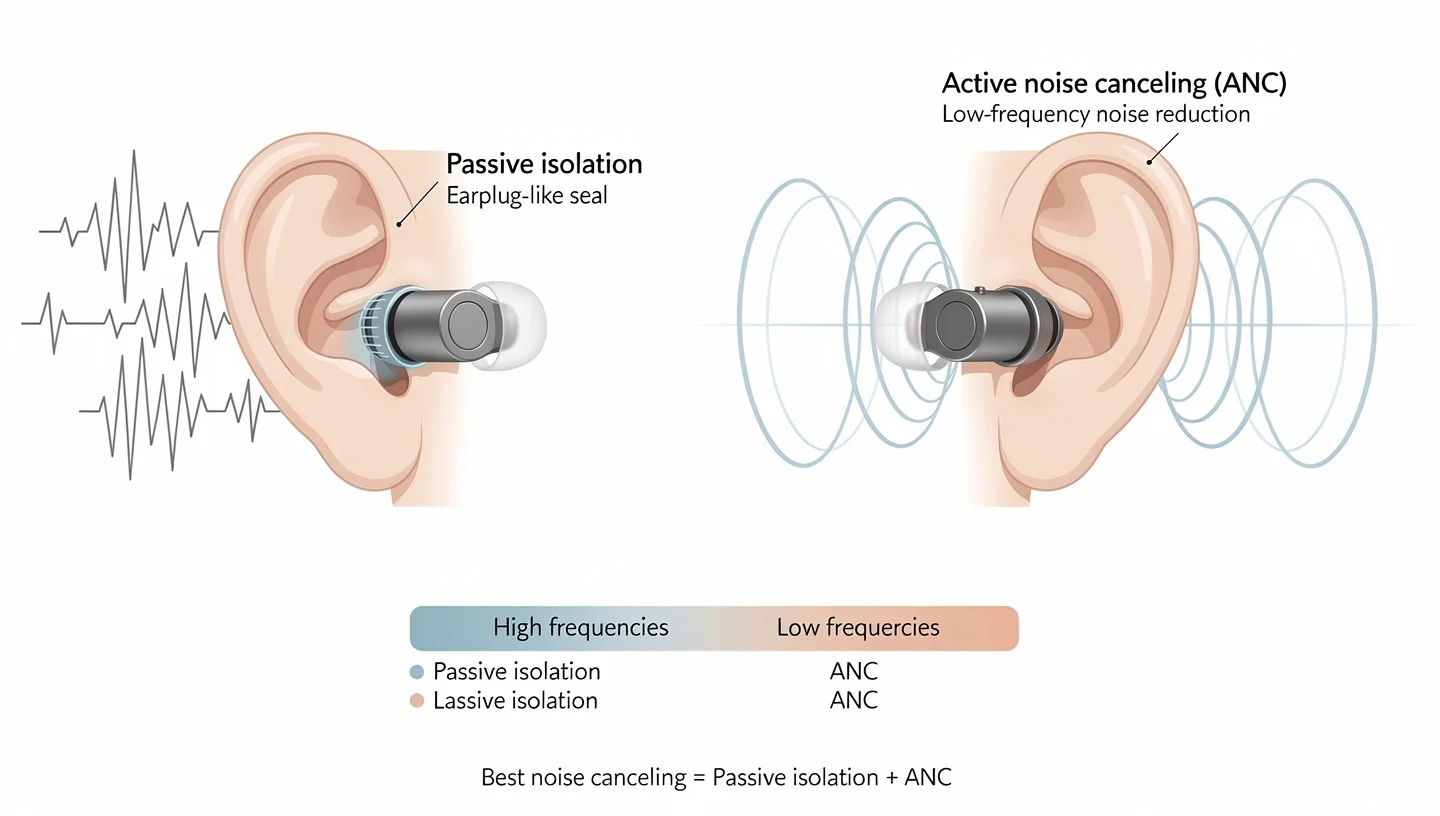
Passive noise isolation is the physical seal created by the ear tip sitting in your ear canal. This is the same principle as wearing earplugs. It blocks sound mechanically, without any electronics or battery power. Passive isolation is especially effective at reducing higher-frequency sounds like voices and sharp noises that ANC has a harder time canceling.
How much sound physically blocks before reaching your ear gets affected by earcup style, padding materials, in-ear seal quality, headband clamping force, internal dampening, driver housing shape and materials. To passive isolation, many aspects of headphone design contribute.
I found that the silicone tips seal against your inner ear. When you turn noise cancellation completely off, you really can’t hear much around you. They’re like earplugs.
When you combine strong ANC with a good ear tip seal, you get the most complete noise reduction possible in earbuds. That is why fit matters so much. If your ear tips do not create a proper seal, both passive isolation and ANC performance will suffer.
I wore the Bose QuietComfort Ultra for almost the entire day during a 15-hour coach journey. Not only were there zero fitting issues, they didn’t fall out and for the most part I forgot they were even there.
However, I never got on with the Beats Studio Buds. Even with ANC turned on, the Studio Buds struggle to reduce ambient sounds. Noise canceling on them is mediocre at best. The included ear tips passively isolate high-frequency sounds, but even with ANC turned on the earbuds struggle to attenuate ambient noises.
The Beauty of Silence Without Music
Even without any audio signal playing, noise-canceling earbuds continue blocking external sounds. My dishwasher ran through its full cycle while I sat a few feet away, and I never heard it. The earbuds stayed powered on, canceling ambient noise without requiring music or podcast playback.
Most ANC headphones will stay on and allow you to enjoy the silence without any signal being applied. You can use the noise canceling headphones to give you silence without having to play music. Many people use ANC headphones with no music playing, just to create a quieter workspace.
For testing the ultimate noise-canceling performance, I brought the Bose QuietComfort Ultra 2 with me to a subway platform in midtown Manhattan and sat as trains entered and left the station. I turned the headphones’ quiet modes on but didn’t play any music or podcasts, just to see how well they silenced the world.
After shooing away tourists trying to buy one of these pairs from me, I noticed that the active noise cancellation was pretty impressive. My corner store has a noisy refrigeration unit. With AirPods Pro on, playing nothing, I couldn’t hear it at all.
I tested the Apple AirPods Pro 3 in a busy coffee shop. The chatter of passers-by was much more tolerable, and I was able to hear more of the actual music as a result.
Active noise cancellation aims to reduce unwanted ambient sounds, significantly improving your listening comfort and focus.
How to Turn On Noise Canceling on AirPods
I’ve been using AirPods Pro for three years paired with my iPhone 13, my MacBook Pro, and my iPad Pro. There are several ways to turn on noise canceling.
The easiest way is to press and hold the force sensor on the stem of one of the earbuds until you hear a chime. This switches between noise canceling and Transparency mode. This cycles between Noise Cancellation, Transparency, and Off.
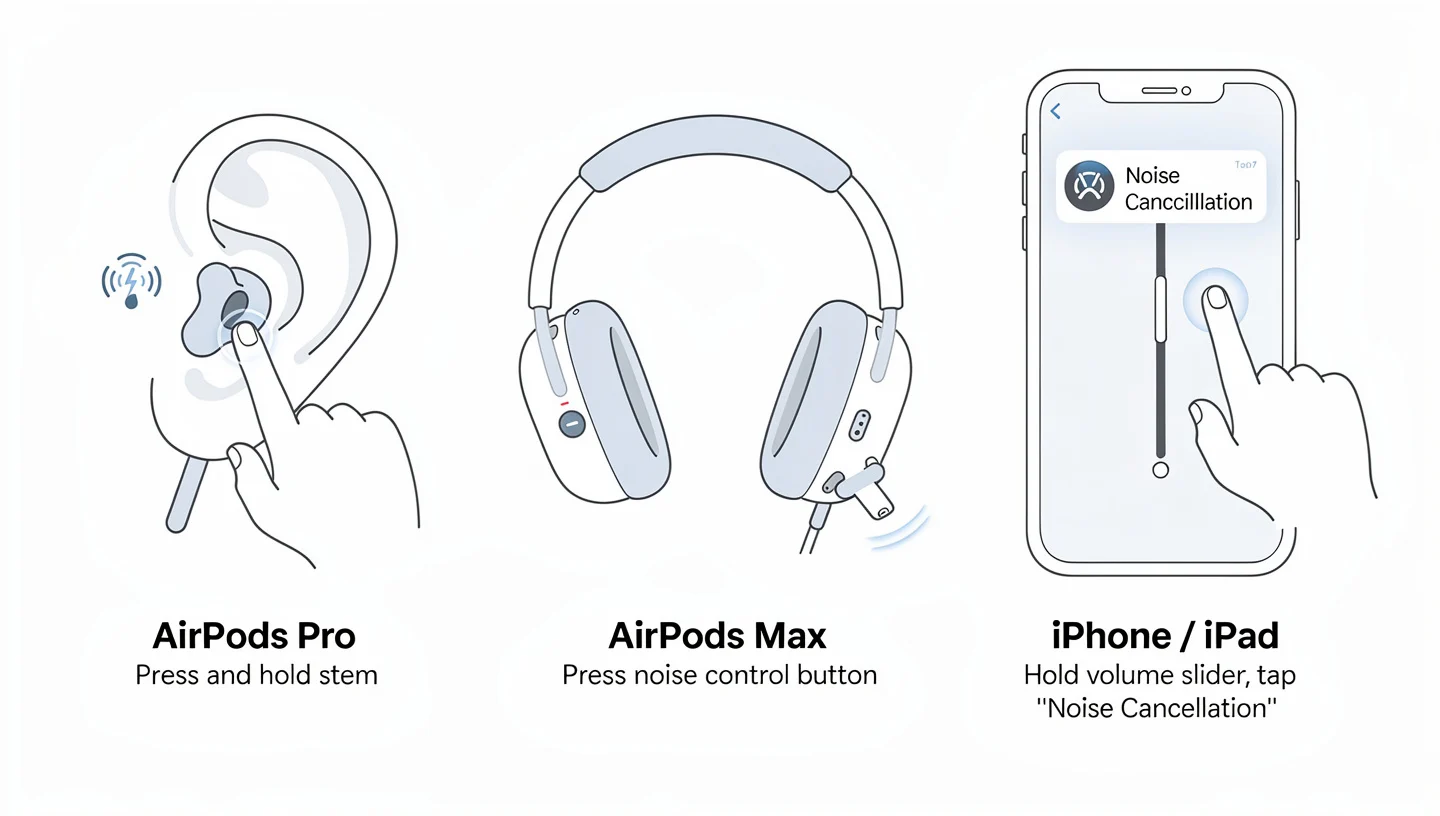
To activate ANC on AirPods Pro or AirPods 4 with ANC, first confirm your earbuds are paired to your iPhone or iPad. Insert the earbuds, then press and hold the force sensor located on the stem. A chime signals that Active Noise Cancellation is now on.
While wearing both AirPods, you’ll hear an activation sound when the feature is turned on. The force sensor is located in the stem of your AirPods Pro, and I found that it’s pretty easy to use while wearing the earbuds.
For AirPods Max, the process is similarly user-friendly. Press the noise control button on the right ear cup to toggle between ANC and Transparency mode. This is the flat silver button opposite the Digital Crown.
You can also swipe down from the top right corner to open Control Center. Press and hold the volume slider until more controls appear. At the bottom left, you’ll see a button for turning on noise canceling.
Connect your AirPods Pro to your iPhone. In the Control Center, look for the music controls. You will find a small icon that resembles a pair of headphones. Tap on this icon to access the noise control settings. Long press the volume slider when it shows the AirPods icon. Tap Noise Control and select Noise Cancellation.
I use this method most often when I’m commuting via public transit. It’s the fastest way to toggle noise control settings while you’re on the go.
On iPhone or iPad, you can enable noise canceling through your device’s Bluetooth settings. Go to the Settings app on your iPhone and iPad, tap on Bluetooth, find your AirPods in the list of devices, and click the info icon next to your AirPods.
Under the Noise Control section, select Active Noise Cancellation. Scroll down to the Noise Control section and tap Noise Cancellation. Once selected, your AirPods will actively block out background noise for a more immersive listening experience.
Here is a video on how to turn on noise cancellation on AirPods:
I personally just don’t use Siri for this, but you can say “Hey Siri, turn on noise canceling” if you want a hands-free solution. Simply say: “Hey Siri, turn on noise cancelling.” Siri will switch modes for you.
Four Noise Control Modes on AirPods
I’ve found that AirPods have four modes since the introduction of the second generation. Active Noise Cancellation, Transparency mode, Adaptive Audio, and Off.
In Active Noise Cancellation mode, all external sounds are reduced or eliminated. Depending on whether you’re playing audio, what you hear is your music or silence.
Transparency mode allows conversation even with earbuds inserted. You can speak with someone standing next to you without removing the AirPods. The feature balances noise canceling with awareness of your immediate surroundings.
You can hear approaching vehicles more clearly when walking near intersections or crossing streets. This feature makes a difference for joggers, runners, and anyone moving through urban areas with traffic.
I use Transparency when chatting at the gym, so I don’t see it being a problem for me. I can hear cars better as they approach crosswalks and other pedestrian crossings.
Adaptive Audio dynamically adjusts the level of noise control based on the surrounding environment. It uses AI to learn from user behavior, optimizing noise cancellation based on previous usage patterns, such as recognizing consistent background noise like a train.
This mode automatically adjusts the noise-canceling effect depending on your current environment. Without you doing a thing, all this happens. So that you don’t audibly notice big changes, ANC levels get adjusted organically by design.
When switched to Off, ANC and transparency both turn off completely. Your AirPods function like standard earbuds with no electronic noise adjustment active.
At the Gym and Walking Through City Streets
I’ve been using noise-canceling earbuds at the gym for the past year. Battery life is exemplary on the Sony WF-1000XM5, coming in at 60 hours with ANC turned on.
When I was out for a run on a busy street and in the gym blocking out dance tunes with my own music, the audio quality was absolutely superb. Everything I listened to had a satisfying boom to it.
I have full ANC on at the gym with my Samsung Galaxy Buds 3 Pro paired with my Galaxy S23. It works so well it actually felt weird because it was so quiet.
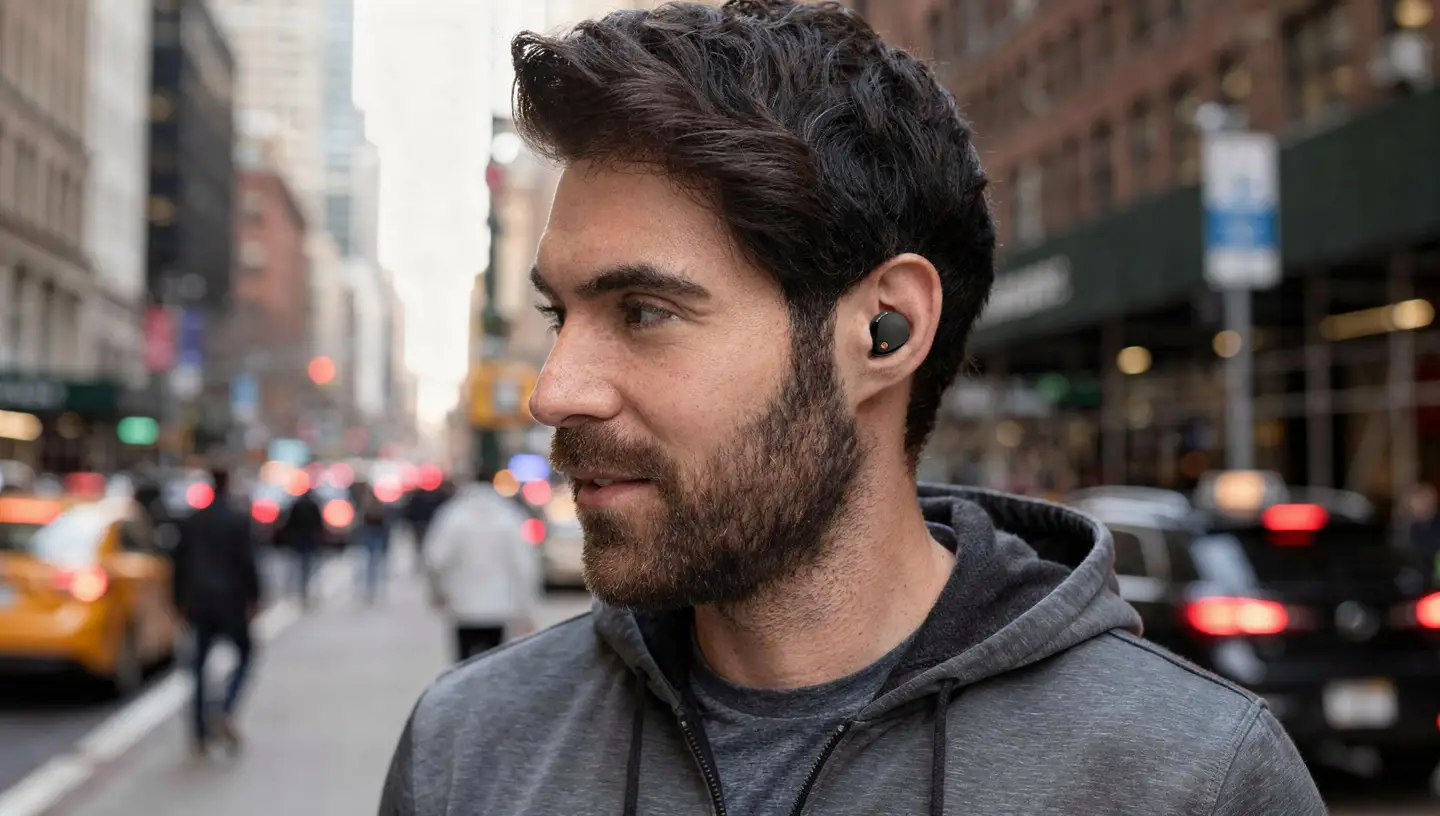
To turn on the feature on Samsung earbuds, first insert both earbuds into your ears. Open the Galaxy Wearable app, and then tap Active noise canceling. You will hear an activation sound when the feature is turned on.
However, I did have some problems with adaptive ANC. During the first usage at the gym where loud music on background was playing, my right ear was having something like beats or shakes which was really unpleasant.
It seems that adaptive ANC tried to adjust to the loud music in gym but it did not work well. I tried to turn off the adaptive function and it helps.
For the Beats Powerbeats Pro 2, they deliver a secure ear hook design that doesn’t budge during intense workouts. The addition of active noise canceling significantly improves sound isolation. If you need noise canceling wireless earbuds with ear hooks that will not fall out during a workout, these are the best option available.
I left for home around 2:30 in the afternoon, and wore the AirPods Pro for the next three hours. On the subway, waiting in the cacophonous Penn Station, on the train ride home, walking through Center City Philadelphia.
The subway, a train ride, and busy city streets are pretty good tests for noise cancellation. Noise cancellation worked really well for me.
Using ANC earbuds on trains and sidewalks requires adjustment. The isolation is strong enough that you lose track of what’s happening around you acoustically. You’ll notice this immediately the first time you wear them in public.
In London itself the ANC continued to impress with the Bose QuietComfort Ultra. In a busy coffee shop, on the London Underground, during a 15-hour coach journey.
I immediately found that I was much safer while crossing the street, and I could more easily guess what the people around me were going to do when I switched to Transparency mode.
Budget Options That Actually Work
You do not need to spend $250 or more to get effective noise canceling. The EarFun Air Pro 4 is proof of that. At under $70, these earbuds offer ANC performance that comes surprisingly close to models costing three times as much.
I found the QuietSmart 3.0 ANC system genuinely impressive for the price. It uses four microphones and does a strong job reducing droning noises, fans, and traffic. In daily use, it keeps background noise under control and you do not need to raise volume too high.
Sound quality leans bass-heavy, which works well for casual listening. The highs are smooth and never harsh. Battery life is about 11 hours per charge with the case providing 52 hours total, and both USB-C and wireless charging are supported.
At an even lower price point, the SoundPEATS Capsule3 Pro+ includes more tech than expected. The noise canceling adapts to changes in your environment automatically. You won’t get Bose or Sony levels of silence, but compared to other budget earbuds, the difference in ANC quality is clear.
Battery life is excellent at 43 hours total with the case, which means you can go days between charges. Sound quality stands out thanks to the xMEMS speaker technology. These solid-state drivers produce a sound that is cleaner and more detailed than what you typically hear from budget earbuds using standard dynamic drivers.
The JLab Go Pods ANC are the cheapest earbuds I’ve ever loved. They’re simply the best budget earbuds money can buy, and there’s no competition. The Go Pods ANC have decent ANC that drowns out environmental noise without kicking up a fuss.
I wrote “the seagulls screeching outside my apartment were pleasantly silenced (as they all should be, controversial opinion),” and I’ll stand by that statement.
Premium Models Worth the Investment
For the Sennheiser Momentum True Wireless 4, I found that they hold their own even if they don’t quite block out external sounds to the same level as the AirPods Pro 3. Sennheiser’s new sound signature was very enjoyable.
The Sennheiser MOMENTUM True Wireless 4 entered a crowded market of active noise canceling earbuds and proved itself, posting 83 percent average noise attenuation in our tests. This makes them an excellent choice for environments like air travel or busy commutes, where effective noise cancelation is crucial.
For the Bowers & Wilkins PX7 S3, while the noise canceling might not be quite as powerful as Bose or Sony, they put more focus on other parts of the formula. They’re a wholly more musical and engaging listen. They bring more detail to the table.
If short battery life is the thing that annoys you most about wireless earbuds, the Master and Dynamic MW09 is worth a look. At 12 hours per charge with ANC on, these earbuds outlast everything else by a wide margin. The case brings the total to about 32 hours.
ANC performance is not as aggressive as Bose or Sony, but M&D includes three presets so you can adjust how much noise blocking you need based on your situation. The real strength of these earbuds is sound quality. The tuning is balanced and natural, with great clarity and detail.
Problems I’ve Had
I’ve tested over 100 noise canceling earbuds. Not all of them worked perfectly.
One pair stopped connecting to any device after three months. The battery died halfway through my workout on more than one occasion.
Pressure changes can be really uncomfortable. My ears feel clogged after frequent use, especially on long flights. Some people notice pressure sensations when ANC activates. Air pressure in the ear canal gets slightly affected by the anti-noise signal. Not harmful, but for certain people, odd or uncomfortable it can feel.
I have to keep pushing them into my ears because they don’t fit my ear canals without Comply foam tips. For best noise canceling, ensure proper seal with correct silicone tips.
I measured a 7-degree temperature increase during cardio with the Beats Fit Pro, which was pretty uncomfortable. The Fit Pro includes active noise canceling and little wings that extend from the earbuds to keep them in place.
Bluetooth was spotty in my crowded gym. Ensure your device’s software is updated to the latest version for ANC. You may need to reset or update your earbuds.
Really Well Worth It
I’ve tested a bunch of different ANC earbuds to find my top picks. The noise canceling of the QuietComfort Ultra gen 2 is incredibly impressive.
They block out everything. I took them on a long train journey, and found that all of the noise of my carriage was completely unnoticeable, even when not listening to music. It’s like magic, as the orchestral sound swells and the noise disappears.
They work pretty well as ANC earplugs as well, doing a decent job with no music playing at all. They sound good, feel comfortable and look pretty cool to boot.
I do wish they had more battery life. Six hours is just okay. But they’re overall my favorite noise-canceling earbuds when I’m commuting via public transit.
Sony’s noise cancellation is so good, in fact, that I can comfortably hear what I’m listening to at less than 25 percent volume. The firm popularized the idea with the X mark series, and they do a great job at blocking just about anything you could hope for, with little sound getting through.
The ANC is now smoother at negating sudden spikes. But they’re still very adept at blocking out the racket that might be keeping your commute from being the relaxing trip it could be.
In my experience, earbuds do a better overall job than over-ear headphones in certain situations. I know which I’d rather buy.
Final Thoughts
I test headphones for a living. I’ve tested lots of wireless earbuds in 2026, and these are the ones I actually recommend.
The technology uses microphones, speakers, and other components to fight noise with noise. Destructive interference cancels out unwanted ambient sounds.
I’ve been using noise-canceling earbuds for three years paired with my iPhone 13, my Pixel 7, my Samsung Galaxy S23, and my MacBook Pro. They’re excellent for commuting, office use, or travel.
Having tested dozens of pairs, the very best noise-canceling earbuds at the moment are the Bose QuietComfort Ultra earbuds. Their ANC is the best we’ve ever experienced, blocking almost all noise around us.
For something under $100, then check out the EarFun Air Pro 4 and SoundPEATS Capsule3 Pro+, which both have excellent ANC and are extremely comfortable to wear. The JLab Go Pods ANC offer the best value under $50.
I couldn’t believe how much I looked forward to using them on my morning commute. The world melts away into nothing, and I’m sealed away into a cocoon filled with my music.
It’s a mind-blowing experience, and I can confirm it really works.